
Twój koszyk
Nie ma więcej produktów w Twoim koszyku
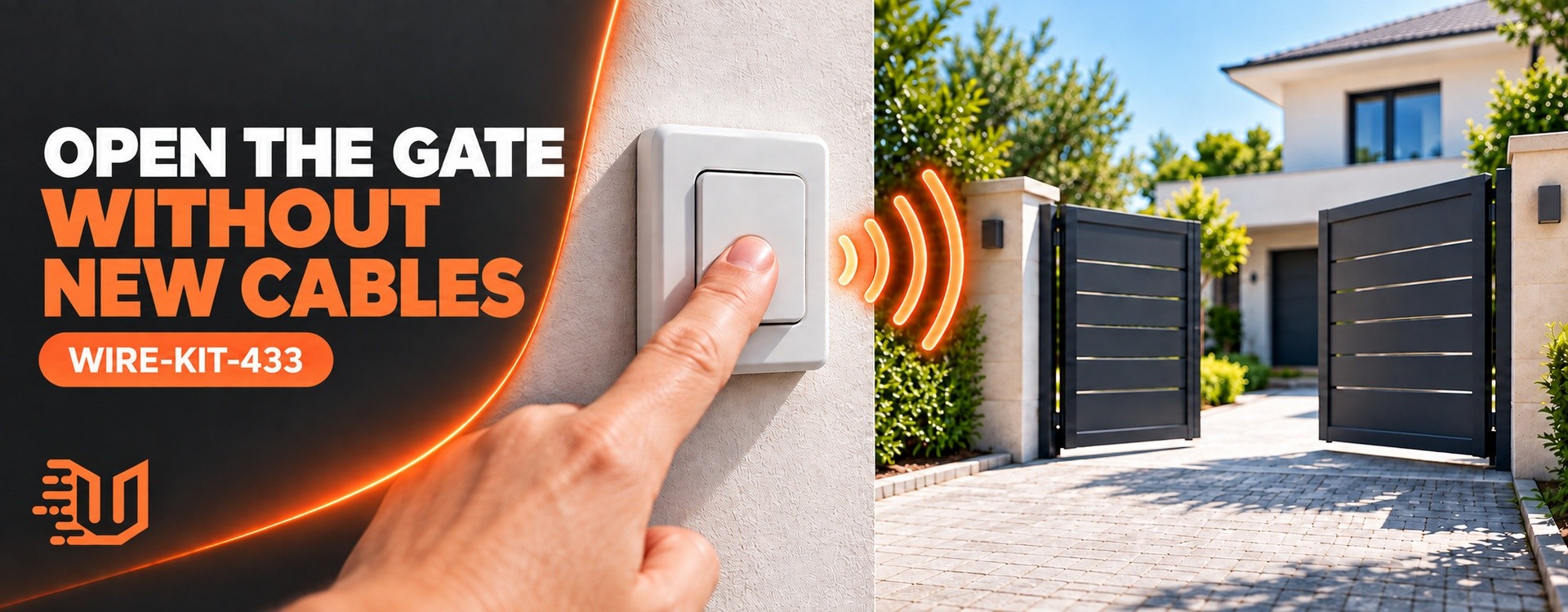
Gate-opening button without new cables? Discover WIRE-KIT-433
“Can you add a button to open the gate?” The problem starts when you need to run the cable.
With WIRE-KIT-433, you can turn an ordinary push button into a radio control. A solution to consider when the connection between the house and the gate automation makes a seemingly simple job more complicated.
Your customer points to a wall: “I'd like it here, next to the door.”
The gate works. The control unit is already installed. All that's needed is one more control point.
Then you look at the cable route.
Perhaps no provision has been made for it. Perhaps the existing route is difficult to use. Or, to reach the control unit, you would need to suggest surface-mounted trunking that the customer would prefer to avoid.
At that point, your quotation needs to explain something that isn't immediately obvious: why adding a simple push button might involve a much bigger job.
Before planning a new cable route, it's worth considering a radio connection.
The button stays a button. The command travels by radio.
WIRE-KIT-433 connects a push button with a normally open (NO) contact to a small transmitter. When the contact closes, the command is sent by radio to the paired receiver, installed near the gate automation.
Local wiring is still required; the cable between the push button and the control unit is avoided.
For the customer, the experience stays straightforward: they go to the control point, press the button and send the opening command. For you, it provides another option to consider when assessing the job.
When a small request risks turning into a big job
Think of a finished home. The owner wants to open the gate from a convenient location, but doesn't want new exposed cable routes or work on the finishes.
In situations like this, the wiring can have a greater influence on the decision than the push button itself.
Offering a radio alternative lets you discuss two separate points with the customer: where they want the control and how you can connect it to the system.
The commercial advantage is being able to offer a solution that addresses the actual problem. In your quotation, you can explain which cable installation tasks are avoided, which connections are still needed and what the installation includes. The customer then has clear information on which to base their decision.
Compact where it matters: next to the push button
The transmitter measures 25 × 52 × 9 mm and is powered by a CR2032 battery. Its dimensions make it easier to fit into small spaces, subject to an on-site check.
When preparing the job, also consider future access. A compact component is useful; being able to reach the battery when it needs replacing makes maintenance easier.
Can you also use an intercom button?
Yes, if the intercom or video intercom provides an NO contact suitable for the transmitter.
This check needs to be made before suggesting the connection. The customer's wish to use an existing button is a good starting point, but you need to check what their system actually provides.
One kit, with options to assess for your system
The package includes one two-channel transmitter and one single-channel receiver. To use the second channel with another automation system, you need a second compatible receiver.
The receiver runs on 12/24 V AC/DC and offers three relay modes: momentary, bistable and ALAYP, which remains active while the button is pressed.
The choice depends on the command required by the control unit. This is the step that turns an accessory into a solution suited to the job.
Two checks to make before ordering
This is a dedicated radio system: the 433 MHz frequency does not guarantee compatibility with other remote controls. Also, the receiver is not waterproof and must be protected from water and moisture.
Assess radio communication between your chosen locations on site as well. Distance, obstacles and component positioning are part of the installation design: a test in the actual environment helps confirm the solution before you complete the installation.
The next time someone asks “Can you add a button?”, you have another option
Every system deserves an assessment. When the cable route is the main challenge, WIRE-KIT-433 is a solution worth considering.
Start with the location where the customer wants the control, check the system and compare the work involved. You may find a more practical way to meet a request that would be difficult to carry out using a wired connection alone.
Need to add a gate-opening button, but routing the cables makes the job more complicated?
View the WIRE-KIT-433 product page on UGATE: you'll find features, operating modes and information to help you assess the kit for your job.
Powiązany produkt

Zestaw radiowy 433 MHz z przewodowym nadajnikiem do przycisku NO i odbiornikiem – WIRE-KIT-433
Cena:69,00 €
WIRE-KIT-433 to zestaw radiowy 433 MHz składający się z jednokanałowego...

Dodaj komentarz